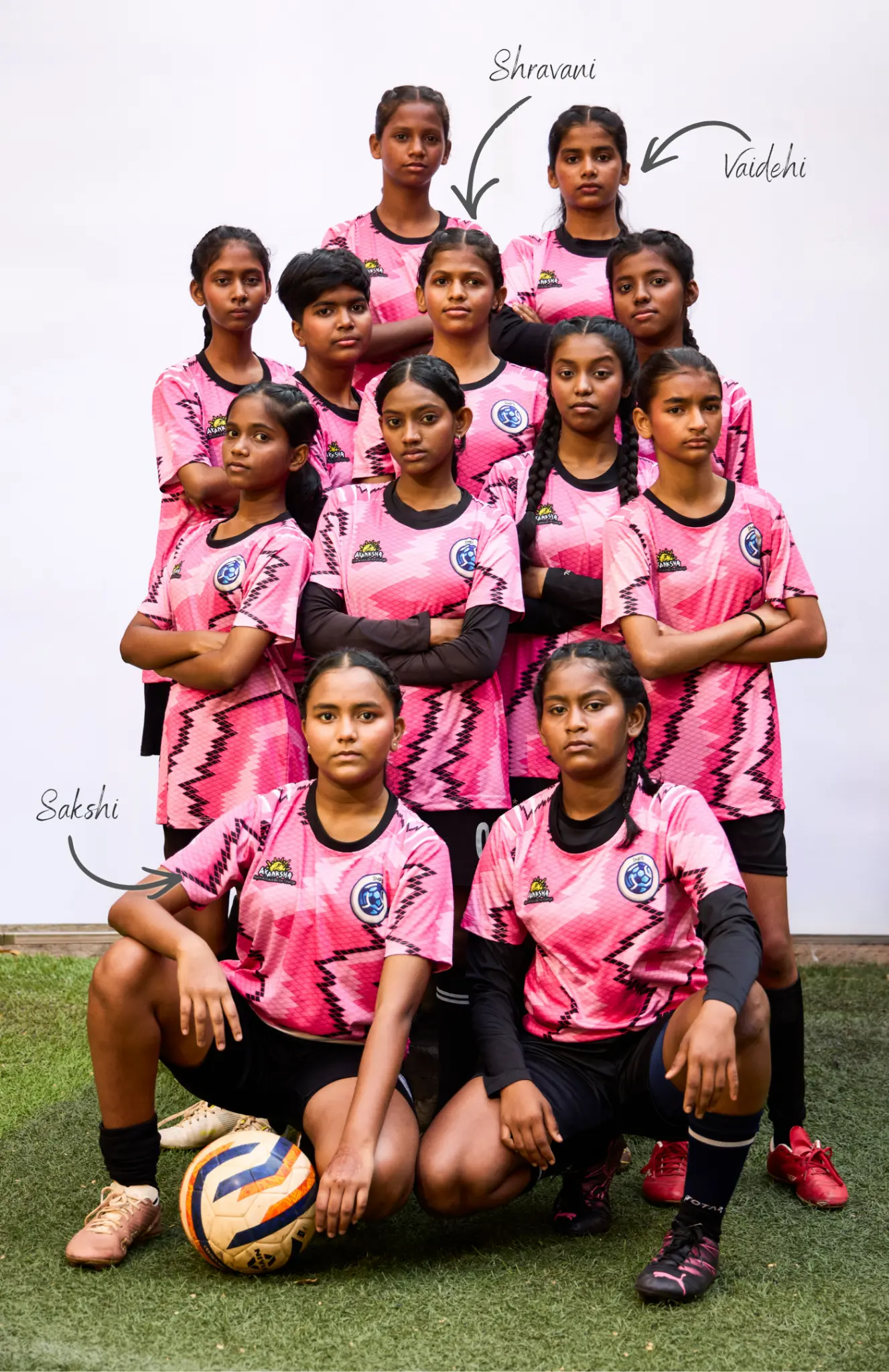
Over the years, there have been many matches that Akanksha's Shindewadi Mumbai Public School's girls' football team has played. But players Vaidehi, Shravani, and Sakshi agree there is one match they will remember all their lives.
"Why should sports belong only to boys?"
It was the match against Cathedral and John Connon School at the annual District Sports Office Tournament, held at the Naigaon Police Grounds. It was a July day in 2025, and the rains had already left the grounds flooded--so much so that pushing the ball forward was difficult.
"Winning against Cathedral was important because when we played against them in other tournaments, Cathedral would be the one to win," says Shravani. "They'd win by one goal or one penalty, and we'd come second," adds Vaidehi.
This time, the team held on to belief, with captain Shravani doing what she does best--motivating her teammates and instilling confidence in them. In that match, the school scored three goals in the penalty round, while the opposing team managed only two.
Shravani and Vaidehi started playing football in Grade 2, when the school's Physical Education teacher at the time encouraged them to train on the school grounds before classes. Seeing her classmates win matches and bring home trophies encouraged Sakshi to take up the sport as well.
Today, Shravani is a midfielder, Vaidehi is a defender who plays left back, and Sakshi plays right back. In 2024, the school's under-17 girls' team qualified for the final of the Subroto Cup, making it the first BMC school to ever qualify for the prestigious inter-school football tournament.
The girls' love for football is also shared by their community. With their fathers playing the sport in open spaces nearby, the girls were naturally drawn to the game. "My dad also plays football, so he encouraged me to play as well," adds Shravani. Their mothers regularly attend matches and cheer them on.
The three acknowledge that not many girls in India are encouraged to pursue sports seriously. "Our parents have shown trust and faith in us and our capabilities--they are the ones who encouraged us the most," says Sakshi.
Now in Grade 10, the students expertly juggle academics with the sport they say has given them confidence and the ability to push themselves to achieve their goals.
On the field, even during training, sports bring many victories--but they also shine a light on failures almost every day. "Yet, it's seeing these failures that makes us want to achieve our goals, even if it means working harder," says Sakshi. The team captain adds, "It's taught us teamwork, discipline, and communication skills--things we carry both on and off the field. And in our studies too."
Their wins are many. Inspired by them, other girls in their school have also taken up sports--football, rugby, kho-kho, and shot put.
The girls say they fell in love with the game after their first win at an inter-Akanksha Futsal tournament. "We were hugging each other and crying--though we don't know why," Vaidehi adds with a smile.
They love the sport but remain practical about the future. While they intend to pursue football, they know that an injury could change that path, so they are also thinking about backup plans. The idea, however, is to always stay connected to the sport.
Their wish is that more women continue playing sports even after school. "One day, while we were on the train heading to a match, a girl older than us asked if we played sports. When I told her we play football, she said she used to play cricket in school and college but has now lost touch with sports," shares Vaidehi. "That makes me sad. Why should sports belong only to boys?"
"I know that as you grow up, many things compete for your time and attention," says Sakshi, "but one should make time for one's interests." "We manage academics too. Sports teaches you to juggle," adds Shravani.
Today, even when school or training grounds are closed, football continues to be a part of their lives. The girls, who all live in the same area, often play on the ground near their homes. Younger girls join them--sometimes even older boys. "And Shravani teaches them new skills and challenges them," laughs Vaidehi.

Continue reading